Engineers and scientists at NASA’s Goddard Space Flight Center in Greenbelt, Maryland, completed tests this month on a second early version of a key element of the upcoming LISA (Laser Interferometer Space Antenna) mission.
The LISA mission, a collaboration between ESA (the European Space Agency) and NASA, will use infrared lasers to detect gravitational waves, or ripples in the fabric of space-time. The tests involved the frequency reference system, delivered by BAE Systems, that will help control the lasers connecting LISA’s three spacecraft. The lasers must be finely tuned to make precise measurements — to within a trillionth of a meter, called a picometer.
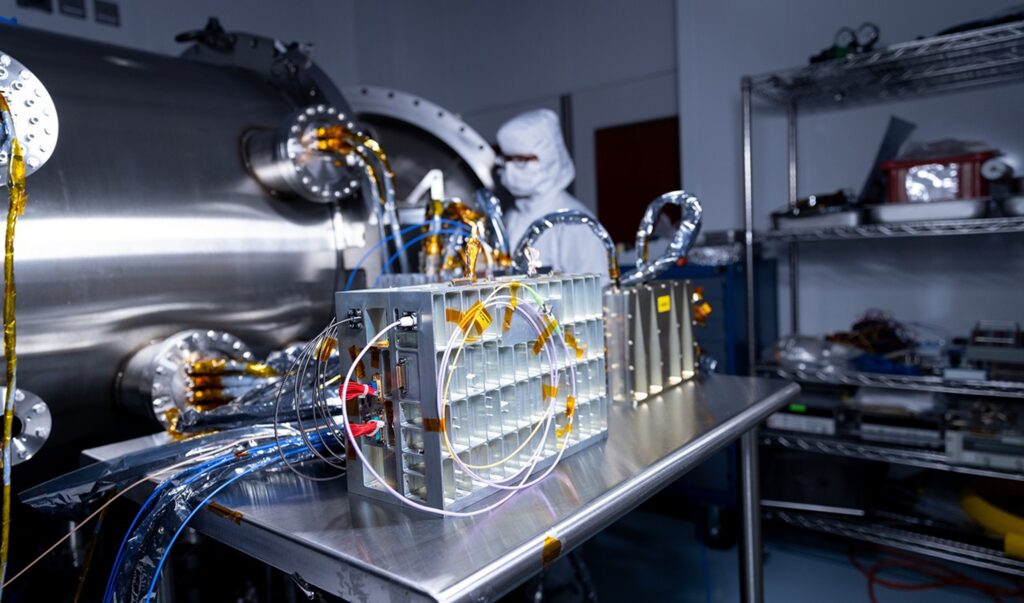
A prototype laser optical module for LISA (Laser Interferometer Space Antenna) rests on a table after testing at NASA’s Goddard Space Flight Center in Greenbelt, Maryland, in May 2025. Xiaozhen Xu, an engineer with Miller Engineering and Research Corp., works in the background. The smaller box to the right is the laser electronics module. Each of the three LISA spacecraft will have a laser system with a frequency reference component and six laser heads. Credit: NASA/Sophia Roberts
[December 3rd 2025] Today, we commemorate the tenth anniversary of the launch of the LISA Pathfinder (LPF) mission. This milestone was a moment of deep pride for the entire LISA Community and the thousands of people who contributed to this extraordinary feat of engineering and science.
LISA Pathfinder was an extremely successful mission that demonstrated our ability to go above and beyond the key technological requirements for the future LISA mission. LPF successfully measured and controlled the motion of the test masses in space with unprecedented precision, effectively removing one of the main technological risks and paving the way for LISA to become reality.
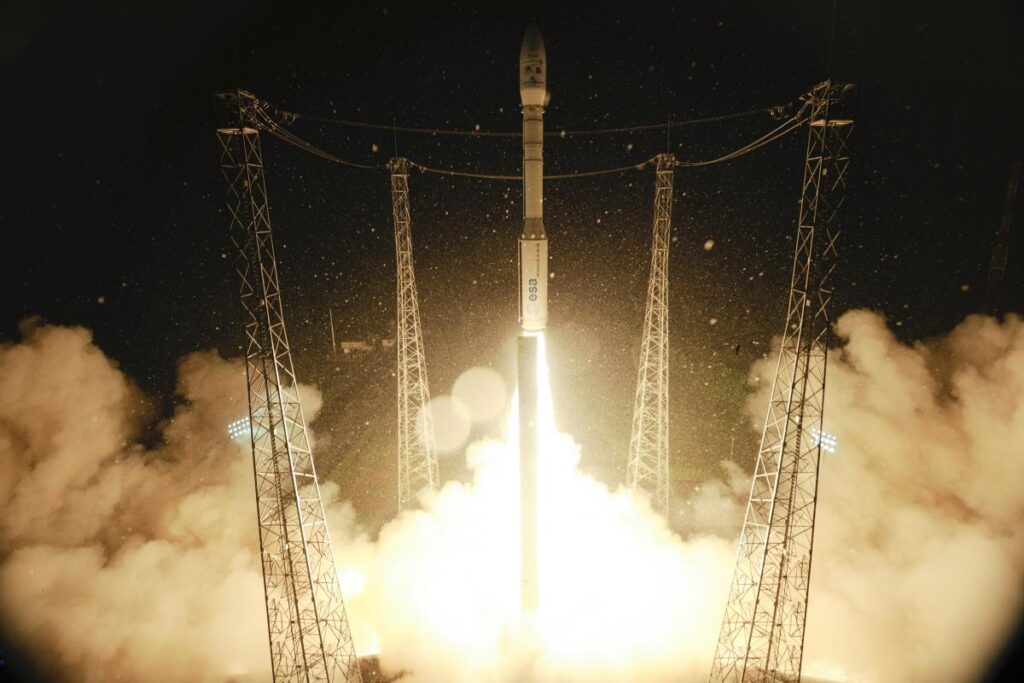
Liftoff of Vega VV06 carrying LISA Pathfinder on 3 December 2015 from Europe’s Spaceport, French Guiana. Copyright: ESA–Stephane Corvaja, 2015
The success of LPF is a testament to the dedication of its international team. This was a scientifically, technologically, and organizationally demanding project whose success created the essential conditions that now enable us to realize the revolutionary potential of LISA.
We are now half way between the launch of LPF and the nominal launch date of the LISA. Looking to the next decade one of our key responsibilities is to ensure the knowledge and expertise developed through the LPF project are passed on to the next generation of scientists and engineers.
-Prof. Dr. Niels Warburton, University College Dublin and Spokesperson of the LISA Consortium
NASA has revealed the first look at a full-scale prototype for six telescopes that will enable, in the next decade, the space-based detection of gravitational waves — ripples in space-time caused by merging black holes and other cosmic sources.
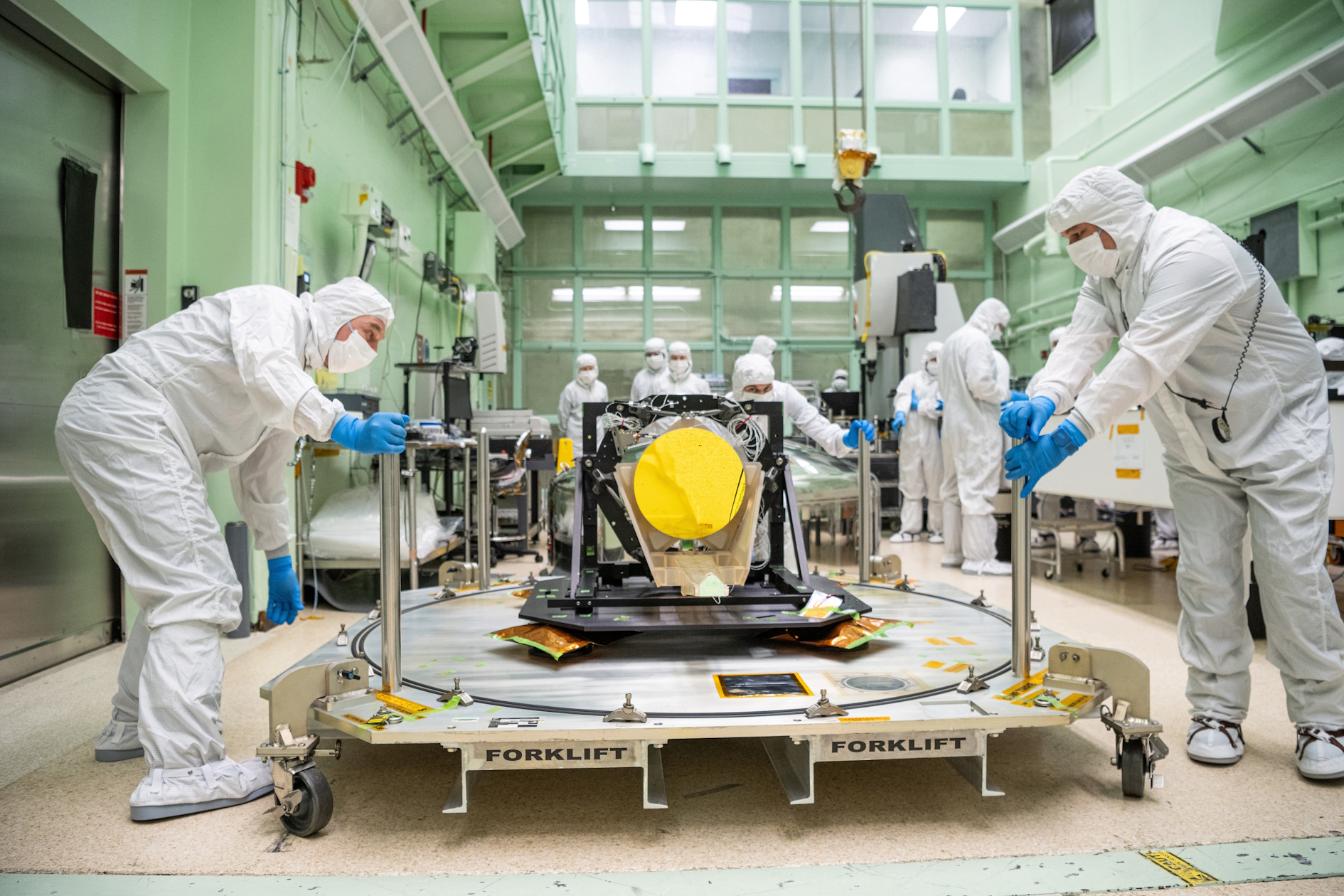
On May 20, the full-scale Engineering Development Unit Telescope for the LISA (Laser Interferometer Space Antenna) mission, still in its shipping frame, was moved within a clean room at NASA’s Goddard Space Flight Center in Greenbelt, Maryland. Credit: NASA/Dennis Henry
The LISA (Laser Interferometer Space Antenna) mission is led by ESA (European Space Agency) in partnership with NASA to detect gravitational waves by using lasers to measure precise distances — down to picometers, or trillionths of a meter — between a trio of spacecraft distributed in a vast configuration larger than the Sun. Each side of the triangular array will measure nearly 1.6 million miles, or 2.5 million kilometers.
“Twin telescopes aboard each spacecraft will both transmit and receive infrared laser beams to track their companions, and NASA is supplying all six of them to the LISA mission,” said Ryan DeRosa, a researcher at NASA’s Goddard Space Flight Center in Greenbelt, Maryland. “The prototype, called the Engineering Development Unit Telescope, will guide us as we work toward building the flight hardware.”
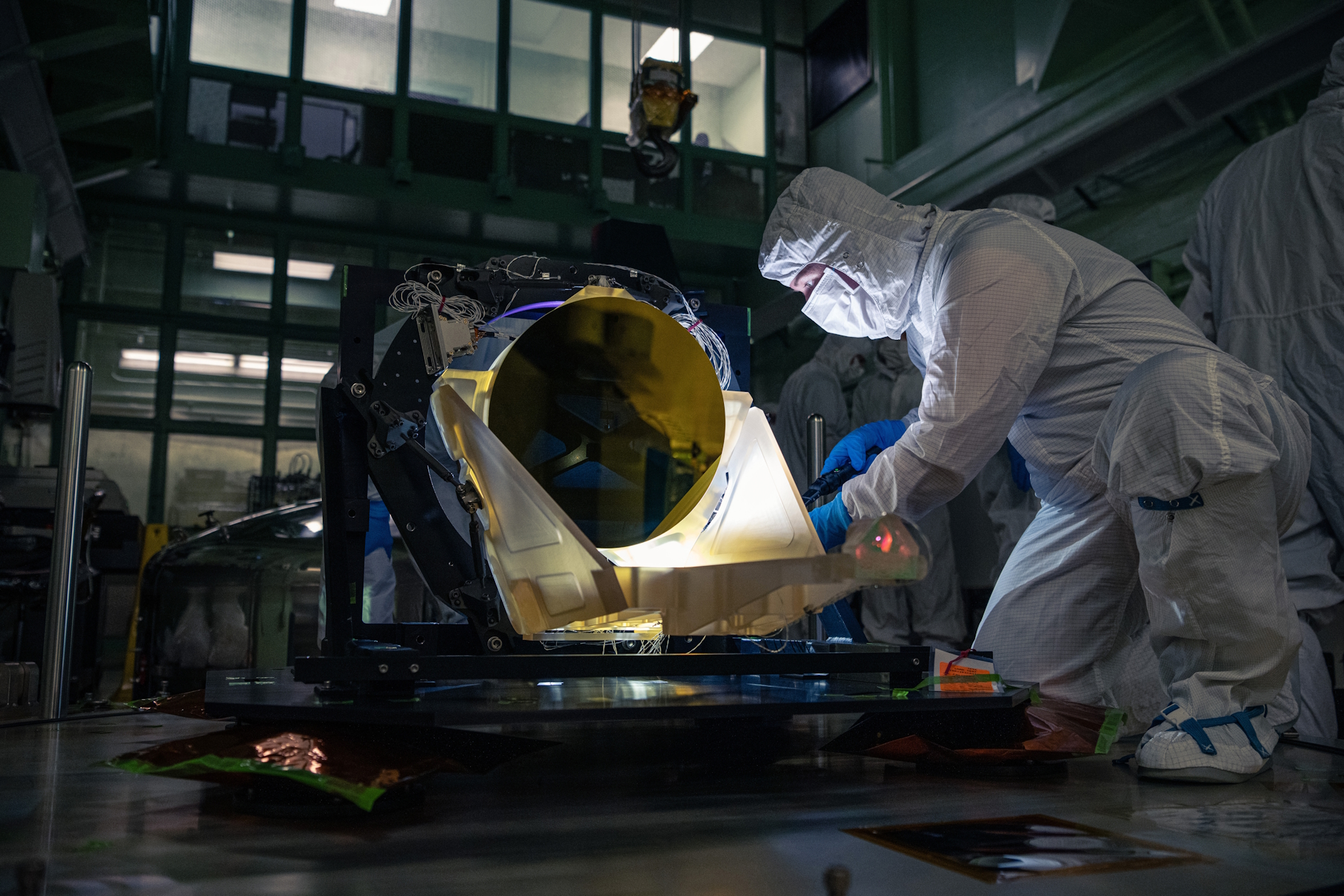
The prototype LISA telescope undergoes post-delivery inspection in a darkened NASA Goddard clean room on May 20. The entire telescope is made from an amber-colored glass-ceramic that resists changes in shape over a wide temperature range, and the mirror’s surface is coated in gold. Credit: NASA/Dennis Henry
The Engineering Development Unit Telescope, which was manufactured and assembled by L3Harris Technologies in Rochester, New York, arrived at Goddard in May. The primary mirror is coated in gold to better reflect the infrared lasers and to reduce heat loss from a surface exposed to cold space since the telescope will operate best when close to room temperature.
The prototype is made entirely from an amber-colored glass-ceramic called Zerodur, manufactured by Schott in Mainz, Germany. The material is widely used for telescope mirrors and other applications requiring high precision because its shape changes very little over a wide range of temperatures.
The LISA mission is slated to launch in the mid-2030s. Download additional images from NASA’s Scientific Visualization Studio
By Francis Reddy NASA’s Goddard Space Flight Center, Greenbelt, Md.
Media Contact: Claire Andreoli 301-286-1940 claire.andreoli(at)nasa.gov NASA’s Goddard Space Flight Center, Greenbelt, Md.
The red book is a comprehensive document which just got published with the LISA adoption. It describes the mission in its whole and is the result of the relentless effort of the LISA Science Study Team.