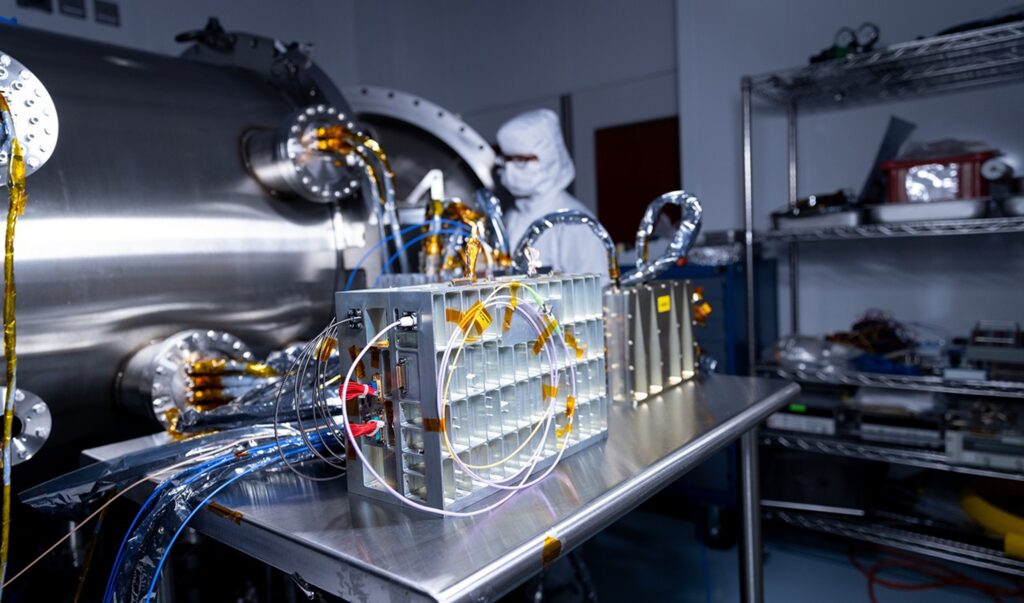
Engineers and scientists at NASA’s Goddard Space Flight Center in Greenbelt, Maryland, completed tests this month on a second early version of a key element of the upcoming LISA (Laser Interferometer Space Antenna) mission.
The LISA mission, a collaboration between ESA (the European Space Agency) and NASA, will use infrared lasers to detect gravitational waves, or ripples in the fabric of space-time. The tests involved the frequency reference system, delivered by BAE Systems, that will help control the lasers connecting LISA’s three spacecraft. The lasers must be finely tuned to make precise measurements — to within a trillionth of a meter, called a picometer.
Read the full story at
https://science.nasa.gov/missions/lisa/nasa-partners-advance-lisa-prototype-hardware/