Skip to content

NASA, Partners Advance LISA Prototype Hardware

Engineers and scientists at NASA’s Goddard Space Flight Center in Greenbelt, Maryland, completed tests this month on a second early version of a key element of the upcoming LISA (Laser Interferometer Space Antenna) mission.

The LISA mission, a collaboration between ESA (the European Space Agency) and NASA, will use infrared lasers to detect gravitational waves, or ripples in the fabric of space-time. The tests involved the frequency reference system, delivered by BAE Systems, that will help control the lasers connecting LISA’s three spacecraft. The lasers must be finely tuned to make precise measurements — to within a trillionth of a meter, called a picometer.

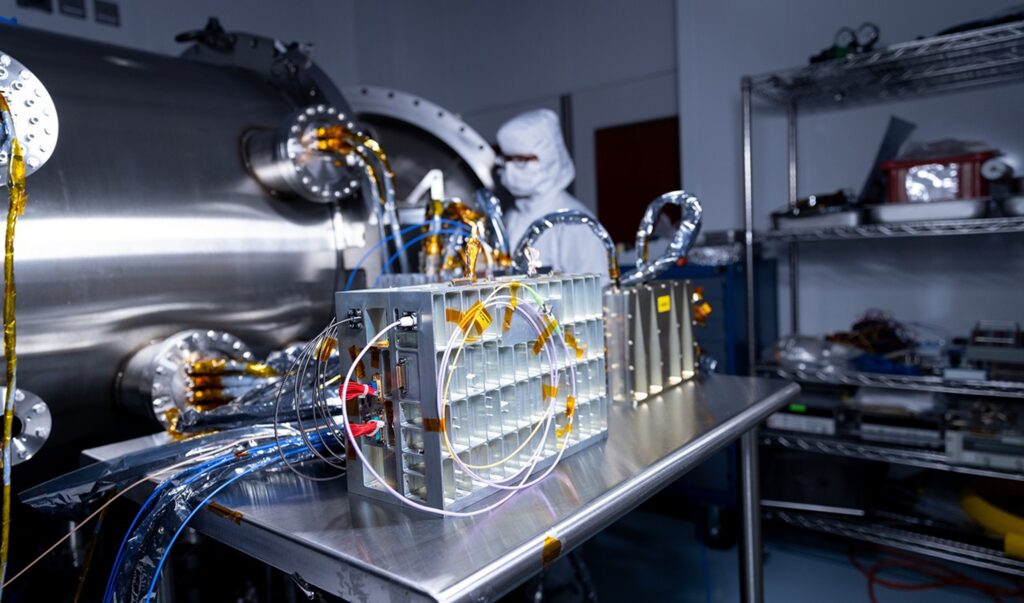
Spacecraft components configured for testing rest on a table.
A prototype laser optical module for LISA (Laser Interferometer Space Antenna) rests on a table after testing at NASA’s Goddard Space Flight Center in Greenbelt, Maryland, in May 2025. Xiaozhen Xu, an engineer with Miller Engineering and Research Corp., works in the background. The smaller box to the right is the laser electronics module. Each of the three LISA spacecraft will have a laser system with a frequency reference component and six laser heads. Credit: NASA/Sophia Roberts

Read the full story at

https://science.nasa.gov/missions/lisa/nasa-partners-advance-lisa-prototype-hardware/

XVI Einstein Telescope Symposium, June 15-19 2026 in Aachen

The upcoming Symposium will take place in Aachen from June 15th at noon until June 19th early afternoon.

Hosted by the RWTH Aachen University, the event will be held at the central campus of the University in the heart of the city of Aachen.

Registrants can also participate in every session online via a two-way zoom connection. Zoom links for each session can be found as an attachment to the session in the Indico timetable.

Social events:

Early Career Researchers Meeting: Monday, 15.06.2026 Conference Dinner: Wednesday, 17.06.2026

Local Organizing Committee:

Markus Bachlechner, Charlotte Benning, Silke Christ, Ruth Jansen, Robert Joppe, Jan Kelleter, Stefan Krischer, Michael Kubocz, Tim Kuhlbusch, Niklas Nippe, Oliver Pooth, Achim Stahl

We look forward to welcoming all participants, both in person and online, for a productive and engaging meeting!

Symposium Website

Deputy System Engineer – Scientific Instrumentation for Space Missions at AEI Hannover

The Max Planck Institute for Gravitational Physics (Albert Einstein Institute) is a world-leading center specializing in gravitational physics, gravitational-wave research, and precision laser interferometry. The institute has more than 400 employees across its Potsdam and Hannover locations. For our Hannover site, we are seeking a:

Deputy System Engineer – Scientific Instrumentation for Space Missions at AEI Hannover

The position is embedded in the “Laser Interferometry in Space” group, which has contributed significantly to missions such as LISA Pathfinder and GRACE-FO and is currently playing a leading role in ESA’s LISA mission. You will join a multidisciplinary and international team working at the forefront of spaceborne gravitational-wave detection.

Your Duties and Responsibilities

  • Support the LISA System Engineer in system engineering activities and progressively assume deputy responsibilities.
  • Coordinate system-level decisions and participate in internal and external technical meetings.
  • Contribute to system design, verification tasks, and technical documentation preparation.
  • Maintain accurate configuration control and documentation.
  • Plan and support Assembly, Integration and Test (AIT) activities.
  • Prepare requirements and procedures for safe hardware handling, shipment, and verification.
  • Operate and verify Ground Support Equipment and test facilities during subsystem and system testing.
  • Participate in verification campaigns at AEI and partner sites.
  • Support Product Assurance (PA) activities, including non-conformance tracking and inspections.
  • Contribute to design reviews, test readiness reviews, and acceptance reviews.
  • Support procurement processes and prepare technical specifications.
  • Collaborate closely with industrial partners, space agencies, and internal project teams.

Your Profile

  • Master’s degree or equivalent in engineering, physics, or a related field.
  • Experience in system engineering, testing, verification, or product assurance.
  • Familiarity with ECSS workflows, test automation, or electronics verification.
  • Hands-on experience with laboratory or test equipment is an advantage.
  • Strong communication skills in English (level C1 minimum); German is an asset but not required.
  • Organisational talent and the ability to manage multiple parallel tasks.
  • Structured and careful working style with strong documentation practices.

We Offer

  • An international, collaborative research environment.
  • Work at the forefront of spaceborne gravitational-wave detection.
  • Regular interaction with ESA, DLR, laboratories, and industrial partners.
  • Access to state-of-the-art laboratories and infrastructure.
  • Competitive salary according to the German TVöD Bund guidelines.
  • Initial 2-year contract with the possibility of extension.

How to Apply
Are you interested? Then we look forward to receiving your online application (cover letter, CV, university certificates, letter of recommendation and other supporting documents) without a photo. Please upload your complete application documents combined into a single PDF on our applicant portal:
https://jobs.aei.mpg.de/245/deputy-system-engineer-scientific-instrumentation-for-space-missions/apply

Questions can be directed to the LISA Program Office (lisa-program-office(at)aei.mpg.de).

The applications received will be considered from January 15th, 2026. The advertisement is valid until the position is filled.

Further information
The Max Planck Society is an equal opportunity employer and is committed to providing employment opportunities to all qualified applicants without regard to race, color, religion, age, sex, sexual orientation, gender identity, national origin, or disability. The Max-Planck-Society is committed to increasing the number of individuals with disabilities in its workforce and therefore encourages applications from such qualified individuals. For more information about our institute, please visit https://www.aei.mpg.de/.

Pease find here details.

Test Engineer at AEI Hannover

The Max Planck Institute for Gravitational Physics (Albert Einstein Institute, AEI) is a world-leading research center specializing in gravitational physics, gravitational-wave detection, and precision laser interferometry. With more than 400 employees across its Hannover and Potsdam locations, AEI plays a key role in several major international space missions. For our Hannover location, we are seeking a motivated:

Test Engineer

to support the verification of the LISA Signal Detection Processing Chain, the LISA Phasemeter and the Ground Support Equipment (GSE) used for testing. The LISA mission is a flagship ESA/NASA project designed to detect gravitational waves from space, offering a unique opportunity to contribute to one of the world’s most ambitious scientific endeavors.

Your Duties and Responsibilities
Execute functional and performance tests of the equipment under test according to ECSS standards.

  • Set up, operate, and validate test benches, measurement equipment, and GSE.
  • Maintain, calibrate, and verify AEI’s GSE and testing infrastructure.
  • Analyze test results, document findings, and support troubleshooting.
  • Prepare test procedures, verification documents, and test reports.
  • Collaborate with system engineering, electronics, software teams, and external partners.
  • Support integration and verification campaigns at AEI and partner facilities.
  • Ensure compliance with quality and product assurance procedures.

Your Profile

  • Master’s degree or equivalent in electrical engineering, physics, systems engineering, or a related technical field.
  • Excellent English skills (C1 level minimum); German is an asset but not required.
  • Hands-on experience with laboratory equipment and measurement systems.
  • Structured, detail-oriented working style and strong analytical skills.
  • Ability to work independently and collaboratively in a technical team.
  • Experience with data analysis tools (e.g., Python, MATLAB) is an advantage.
  • Familiarity with precision measurement systems or ECSS standards is beneficial but not required.
  • Motivation to contribute to a major international space mission.

We Offer

  • The opportunity to work on a globally leading space science project.
  • A dynamic, international research environment with highly skilled teams.
  • Hands-on experience with cutting-edge instrumentation and test facilities.
  • Professional development opportunities and room to grow into broader responsibilities.
  • Flexible and supportive working conditions within the Max Planck Society.

How to Apply
Are you interested? Then we look forward to receiving your online application (cover letter, CV, university certificates, letter of recommendation and other supporting documents) without a photo. Please upload your complete application documents combined into a single PDF on our applicant portal:https://jobs.aei.mpg.de/244/test-engineer/apply

Questions can be directed to the LISA Program Office (lisa-program-office(at)aei.mpg.de). 

The applications received will be considered from January 15th, 2026. The advertisement is valid until the position is filled.

Further information
The Max Planck Society is an equal opportunity employer and is committed to providing employment opportunities to all qualified applicants without regard to race, color, religion, age, sex, sexual orientation, gender identity, national origin, or disability. The Max-Planck-Society is committed to increasing the number of individuals with disabilities in its workforce and therefore encourages applications from such qualified individuals. For more information about our institute, please visit https://www.aei.mpg.de/.

Please find here details.

Supermassive Black Holes and Blue Notes, June 29 – Juli 3 2026 at Université de Montréal

Held a week before the world-renowned Montreal International Jazz Festival, the conference aims to spotlight the significant progress made in the study of supermassive black holes, addressing open questions and exploring future prospects, particularly in the wake of the latest observations from JWST.

Main themes

  • Advanced Techniques for Measuring Supermassive Black Hole Properties
  • Observations of Supermassive Black Holes at the Event Horizon Scale
  • Feeding and Feedback Processes of Supermassive Black Holes
  • High-Redshift Supermassive Black Hole Formation and Growth

Registration Info

Registration has not opened, but you can pre-register here, and we will keep you updated.

Organising Committees

Scientific Organising Committee (SOC):
Julie Hlavacek-Larrondo (UdeM)
Martin Bureau (Oxford)
Daryl Haggard (McGill)
Romeel Dave (Edinburgh)
Claude-Andre Faucher-Giguere (Northwestern)
Frank Eisenhauer (MPE)
Chiara Mingarelli (Yale)
Sara Issaoun (Harvard & Smithsonian Center for Astrophysics)
Roberto Maiolino (Cambridge/Kavli)
Priya Natarajan (Yale)

Local Organising Committee (LOC):

Julie Hlavacek-Larrondo (UdeM)
Martin Bureau (Oxford)
Daryl Haggard (McGill)
Marine Claude Anne Prunier (UdeM)
Olivia Pereira (UdeM)
Benjamin Vigneron (UdeM)
Hyunseop Choi (UdeM)
Hengyue Zhang (Oxford)
Anabel X. Li (UdeM)

Conference Website

From Black Holes to the Cosmos, August 24-28 at SISSA, Trieste

This conference honors the scientific legacy of Matt Visser, whose pioneering work has profoundly influenced our understanding of general relativity, quantum field theory in curved spacetime, wormholes, energy conditions, analogue gravity, and beyond. Gathering colleagues, collaborators, and students from around the world, the meeting will highlight recent developments at the interface of geometry, gravitation, and quantum theory, while celebrating Visser's distinctive contributions to these fields. The conference will be hosted in the Aula Magna of SISSA Miramare Campus.

Invited speakers (TBC):

Matt Visser
Carl Bender
Ivan Booth
Erik Curiel
Fay Dowker
Ted Jacobson
Eleni-Alexandra Kontou
Francisco Lobo
Robert Mann
Erik Poisson
Ralf Schützhold
Thomas Sotiriou
Bill Unruh
Cliff Will
David Wiltshire

Conference Website

4th LISA Sprint, May 11-13, 2026 in Bozeman, Montana

The Laser Interferometer Space Antenna (LISA) is a joint effort of ESA and NASA to develop and operate the first space-based observatory of gravitational waves (GWs) in the millihertz frequency band. To prepare for LISA observations and its unique data products, we are organizing the 4th LISA Sprint in Bozeman, Montana, from Monday May 11 to Wednesday May 13, 2026.

In past LISA Sprints the participants all pitched project ideas at the workshop, and teams selecting the projects they wanted to work on. This time will be a little different. While additional project pitches are still welcome, the focus will be on several pre-defined projects that have been identified as critical needs by the NASA Science Ground Segment team. Participants will be asked to list their preferences for which of the pre-define projects they would be most interested in contributing to in advance of the workshop.

This will be a hands-on workshop: there will be no talks–only brief project descriptions at the beginning of the workshop, and “show and tell” at the close of the meeting to share progress with the group.

In late January 2026 we will advertise the meeting website and application form for interested participants. Please note that space will be limited, so applying does not guarantee acceptance. Accepted applicants will be notified by the end of February. There is no financial support available to attend the meeting, nor is there any registration fee for participating.

16th International LISA Symposium, June 21-26, 2026, College Park, Maryland

We welcome you to the 16th International LISA Symposium! Continuing from past editions, the Symposium will highlight gravitational wave astrophysics, with a primary focus on the most up-to-date mission development, theory and analysis enabling the science to be done with the Laser Interferometer Space Antenna. The Scientific Organizing Committee is planning an engaging program of invited talks and special sessions to be complemented by your contributions of talks, posters, questions and discussions. We look forward to bringing together a wide cross-section of the international community, including students (with a discounted registration fee).

The Symposium will take place on the University of Maryland campus in College Park, Maryland, USA, beginning with registration and a welcome reception on the evening of Sunday, June 21. Scientific sessions (plenary, parallel and poster) will be held Monday through Friday, June 22 to 26, ending in the mid-afternoon on Friday. Breakfast and coffee breaks will be in the room where posters are displayed. A public lecture is being planned on Tuesday evening. Following tradition, Wednesday afternoon is kept open and a variety of local activities, ranging from organized to informal, will be available depending on your interests; details will be posted on this website.

We recognize the constraints and concerns about international travel and want to support scientists who are unable to attend in person while still maintaining the value of a lively in-person meeting. While remote attendance will be possible, the number of remote presentations will be limited and the selection of submitted abstracts will prioritize in-person talks and posters. Maryland prides itself on being a welcoming state and a home to many cultures, and we hope you will take part in symposium if you are able to.

Registration and abstract submission are now open. You may submit an abstract and register (and pay) all at once, or at different times.

Scientific Organizing Committee

  • Shane Larson (Chair), Clarkson University
  • Stanislav Babak, APC – Paris
  • Richard Brito, Instituto Superior Técnico
  • Maria José Bustamante Rosell, Fisk & Vanderbilt Universities
  • Laurentiu Caramete, Institute of Space Science, Bucharest-Magurele
  • Eleonora Castelli, University of Maryland, Baltimore County & NASA GSFC
  • Maria Charisi, Washington State University & University of Crete
  • Nelson Christensen, Observeratoire Cote d’Azur
  • John Conklin, University of Florida
  • Neil Cornish, Montana State University
  • Daniel J. D’Orazio, Space Telescope Science Institute
  • Deborah Ferguson, University of Rhode Island
  • Alessia Franchini, Università degli Studi di Milano
  • Daryl Haggard, McGill Unviersity, Trottier Space Instittue
  • Zoltan Haiman, Institute of Science & Technology Austria
  • Sarah Vigeland, University of Wisconsin Milwaukee
  • Stefano Vitale, Università di Trento
  • Gudrun Wanner, AEI – Hannover
  • David Weir, University of Helsinki
  • Helvi Witek, University of Illinois Urbana-Champaign
  • William Joseph Weber, Università di Trento

Local Organizing Committee

Peter Shawhan, University of Maryland
Ann Hornschemeier Cardiff, NASA Goddard Space Flight Center
Ira Thorpe, NASA Goddard Space Flight Center
Elizabeth Ferrara, University of Maryland & NASA GSFC
Bernard Kelly, University of Maryland, Baltimore County & NASA GSFC


First held in 1996, the International LISA Symposium is held every two years to celebrate and share infornation and science related to the Laser Interferometer Space Antenna mission, a three-arm space-based gravitational wave detector being developed by the European Space Agency (ESA).

LISA Symposium Conference Website

History

A listing of prior LISA Symposia and links to their websites can be found here.

Gravity2026: New Frontiers in Cosmology, April 27 – May 1 2026 in Daejeon

GRAVITY2026: New Frontiers in Cosmology will be held on-site at the Institute for Basic Science (IBS) in Daejeon, Korea, from 27 April to 1 May, 2026. The aim of the workshop is to foster comprehensive and in-depth discussions on the rapidly expanding frontiers of gravitational physics. The program will cover a wide spectrum of topics central to cosmology, including gravitational waves, early- and late-time cosmology, and theories of modified gravity.

This workshop is mainly organized by the IBS Center CTPU-CGA and is held on-site at the Institute for Basic Science in Daejeon, Korea. There is no registration fee. f you wish to attend, please register by 29 March 2026, 23:59 KST. We will also accept a number of contributed talks: if you wish to give a contributed talk, please register for the workshop by the above date and submit a title and abstract by 5 Apeil 2026, 23:59 KST. The selection will be made by the organizing committee.  Please note that we are not able to support VISA applications from non-invited speakers except in special cases. 

For information about previous events, please see:

Gravity2022: Current challenges in black hole physics and cosmology

Gravity2023: Dawn of field theoretic approach

Gravity2025: New horizon of black hole physics

Important deadlines:

Registration: 29 March 2026, 23:59 KST

Abstract submission: 5 April 2026, 23:59 KST

Confirmed Invited Speakers:

Ana Achucarro (Leiden U, Netherlands)

Antonio De Felice (YITP, Japan)

Jaume Garriga (ICCUB, Spain)

Fawad Hassan (Stockholm U, Sweden)

Donghui Jeong (Penn State U, USA)

Matteo Magi (IBS, Korea)

Takahiro Matsubara (KEK, Japan)

Shinji Mukohyama (YITP/RESCEU, Japan)

Nils Albin Nilsson (IBS, Korea)

Changbom Park (KIAS, Korea)

Seong Chan Park (Yonsei U, Korea)

Mairi Sakellariadou (King’s Coll. London, UK)

Misao Sasaki (APCTP/IPMU, Korea and Japan)

Teruaki Suyama (Institute of Science Tokyo, Japan)

Gianmassimo Tasinato (Swansea U, UK)

Niels Warburton (University Coll. Dublin, Ireland)

Local Organizing Committee:

Sebastian Bahamonde, Mohammad Ali Gorji, Dong-Won Jung, Nils Albin Nilsson, Hyunbae Park, Masahide Yamaguchi

Scientific Advisory Committee:

Katsuki Aoki (YITP), Antonio De Felice (YITP), Francesco Di Filippo (Goethe U.), Mohammad Ali Gorji (IBS), Shinji Mukohyama (YITP/RESCEU), Naritaka Oshita (YITP), Masroor C. Pookkillath (Sogang U.), Kazufumi Takahashi (Nihon U.), Masahide Yamaguchi (IBS)

Contact:

For general inquiries, please use ctpu-cga-admin(AT)ibs.re.kr

Workshop Website
WE Heraeus Physics School und 62. Karpacz Winter School in Theoretical Physics “Multimessenger Astrophysics and Cosmology”, February 28 – March 6 2026 in Karpacz

The WE Heraeus Physics School and the 62nd Karpacz Winter School in Theoretical Physics "Multimessenger Astrophysics and Cosmology" will be held from 28 February to 6 March 2026. 

Compact stars, dense remnants of supernovae, compress about 1.4 solar masses into a 10 km radius—reaching densities beyond atomic nuclei. Their extreme compactness makes them unique laboratories for high-density matter. Gravitational-wave detections of binary neutron star mergers now allow direct probes of such conditions, with hot, dynamic post-merger remnants offering complementary insight to cold pulsars.

With next-generation observatories like the Einstein Telescope and Cosmic Explorer, multi-messenger astrophysics—combining gravitational waves, electromagnetic signals, and neutrinos—will sharpen constraints on the dense-matter equation of state, extreme gravity, and heavy-element nucleosynthesis. Mergers also serve as standard sirens, enabling independent measurements of the Hubble constant.

The school will cover the thermal history of the Universe after its first second, from the quark–hadron transition to neutrino decoupling, linking microphysics to cosmological observables. Topics include the Hubble tension, modified gravity, primordial magnetic fields, compact-object mergers, future gravitational-wave science, and primordial black holes as dark-matter or galaxy-seed candidates—offering a unified view across astrophysics, cosmology, and particle physics.

School Website