Skip to content

Research Fellow in Nanohertz Gravitational Waves at University of Birmingham

University of Birmingham is seeking to appoint a postdoctoral researcher to work on developing analysis approaches for low frequency observations of gravitational waves to improving our understanding of the formation and evolution of supermassive black holes. The applicant will join the Institute for Gravitational Wave Astronomy at the University of Birmingham, United Kingdom – one of the globally leading institutes in gravitational wave-research. The successful applicant should have a background in data analysis techniques and in astrophysics of massive black hole binaries. Apply Before 10/01/2026, 12:59 AM.

The Institute for Gravitational Wave Astronomy provides a vibrant and diverse environment with expertise across key areas of gravitational-wave astronomy: From theoretical to experimental gravitational-wave research, with applications to present and future-generation detectors, theoretical astrophysics, transient astronomy, gravitational-wave source modelling including numerical relativity, and general relativity theory.

The School of Physics and Astronomy is a world-leading physics department, excelling in both research and teaching. Our physics research was recently ranked top in the UK for 4-star-category research, and 4th by GPA, by the Research Excellence Framework 2021. The 2016 Nobel Prize in Physics was awarded to Professor Mike Kosterlitz and Professor David Thouless jointly for their work into the discoveries of the properties of matter, work which started when they were at Birmingham together. The 2017 Nobel Prize was awarded for the detection of gravitational waves, in which Birmingham staff played a key role. The School is an excellent environment for an upcoming academic.

The School’s research portfolio is wide-ranging, and covers three principal themes: Quantum Matter; Particle and Nuclear Physics; and Astronomy and Experimental Gravity. It has over 120 academic and research staff together with 120 graduate students with around 50 technical and clerical support staff.

The University of Birmingham is an equal opportunity employer. The School of Physics and Astronomy is an Athena SWAN Silver Award holder and JUNO Champion, welcomes people from all backgrounds and is committed to fostering an inclusive environment where diversity is at the heart of who we are. We encourage applications from all qualified applicants; those from traditionally under-represented groups in this discipline are particularly welcome.

Role Summary

  • Working within specified research grants and projects and contributing to writing bids
  • Operating within the area of gravitational-waves and astrophysics
  • Developing and implementing analysis approaches for single source and populations in the context of nanohertz gravitational-wave observations
  • Applying probabilistic inference to gravitational waves, including through machine learning techniques
  • Analyse and interpret research findings and results
  • Contribute to generating funding

Main Duties

The responsibilities may include some but not all of the responsibilities outlined below.

  • Develop research objectives and proposals for own or joint research, with assistance of a mentor if required
  • Contribute to writing bids for research funding
  • Analyse and interpret data
  • Apply knowledge in a way which develops new intellectual understanding
  • Disseminate research findings for publication, research seminars etc
  • Supervise students on research related work and provide guidance to PhD students where appropriate to the discipline
  • Contribute to developing new models, techniques and methods
  • Undertake management/administration arising from research
  • Contribute to Departmental/School research-related activities and research-related administration
  • Contribute to enterprise, business development and/or public engagement activities of manifest benefit to the College and the University, often under supervision of a project leader
  • Collect research data; this may be through a variety of research methods, such as scientific experimentation, literature reviews, and research interviews
  • Present research outputs, including drafting academic publications or parts thereof, for example at seminars and as posters
  • Provide guidance, as required, to support staff and any students who may be assisting with the research
  • Deal with problems that may affect the achievement of research objectives and deadlines
  • Promotes equality and values diversity acting as a role model and fostering an inclusive working culture.

Person Specification

  • PhD (or near to completion) in Physics, Astrophysics, or a related subject
  • High level analytical capability
  • The ability to communicate complex information clearly
  • Understanding of and ability to contribute to broader management/administration processes
  • The ability to assess resource requirements and use resources effectively
  • The ability to contribute to the planning and organising of the research programme and/or specific research project
  • The ability to coordinate work with others and to work within a research team to achieve common goals, avoid conflict or duplication of effort
  • Knowledge of the protected characteristics of the Equality Act 2010, and how to actively ensure in day to day activity in their own area that those with protected characteristics are treated equally and fairly
  • The fluency in relevant models, techniques or methods and ability to contribute to developing new ones
  • Fluency and experience with high performance and/or high throughput computing
  • Expertise in the theory and usage of high-level Bayesian and/or frequentist statistical data analysis techniques, including stochastic processes and machine learning; expertise in analytical and numerical modelling of gravitational-wave sources, and the astrophysical processes governing their populations; expertise in analysing and interpreting pulsar timing array datasets.

Informal enquiries to Bence Becsy, email: b.becsy(at)bham.ac.uk

Please find here details.
PhD Researcher in Compact High-Precision Sensors for Science and Industry at nikhef

This vacancy is for a four-year PhD position focusing on the development of the optical readout of the CHiPS sensor. Your research will centre on a homodyne quadrature interferometric readout, with the aim of combining high sensitivity with the robustness and stability required for continuous operation. You will investigate and develop the interferometric sensing architecture through modelling, experimental development and characterisation. The readout will be designed to operate in both open-loop mode, using fringe counting, and closed-loop mode. Developing the closed-loop system will involve close collaboration with the control-design PhD researcher at TU Delft, while achieving a robust and compact sensor will require close interaction with the optomechanics PhD researcher. The deadline for applications is Sunday 4 October 2026 at 23:59 CEST.

The position

Many state-of-the-art sensors demonstrate exceptional performance in the laboratory, but achieving that performance can require careful manual optimisation, frequent recalibration or precise realignment. Such an approach is not sufficient for applications that require sensors to operate continuously and autonomously in demanding environments.

The CHiPS (Compact High-Precision Sensors) project aims to address this challenge by combining advanced sensing and control techniques into compact, robust and extremely high-performance inertial sensors. The goal is to move beyond laboratory demonstrations and develop sensors that can operate reliably for extended periods without manual intervention. The resulting technology will target applications ranging from semiconductor manufacturing to next-generation gravitational-wave detectors.

The CHiPS project is being carried out by a team of three PhD researchers: one based in the gravitational-wave research group at Nikhef (this vacancy) and two based in the Precision and Microsystems Engineering (PME) department at Delft University of Technology. The three PhD projects address complementary aspects of the sensor:

  • optical readout and interferometric sensing at Nikhef;
  • optomechanical design at TU Delft; and
  • sensing, control and feedback at TU Delft.

The project is funded through the Dutch National Growth Fund NXTGEN programme of NWO and is carried out in collaboration with industrial and academic partners, including ASML.

Please find here full details

Research Position (Postdoc) in the field Gravitational Wave Detector Instrumentation at Leibniz Universität Hannover

The Institute for Gravitational Physics invites applications for the following position starting at the earliest possible date: Research Position (Postdoc) in the field Gravitational Wave Detector Instrumentation (salary scale 13 TV-L, 100 %). The fixed-term position is limited to 3 years. 

This position is part of the project “Developing a modular suspension platform interferometer for the Einstein Telescope” which aims to investigate and design an ultra-sensitive interferometric sensor for sensing and controlling the motion between seismically isolated platforms for the next generation Einstein Telescope gravitational wave detector.

The research will be carried out at the 10m Prototype Facility (https://10m.aei.mpg.de/) which is jointly operated by Leibniz University Hannover and the Max Planck Institute for Gravitational Physics. This project will build upon pioneering research conducted in this research group and ensure that a design of an inter-platform sensor specific for Einstein Telescope will be mature and ready for installation. 

Your responsibilities 

  • Deriving requirements for inter-platform motion in Einstein Telescope and utilising available simulation tools and working closely with other working groups within the Einstein Telescope collaboration
  • Supporting the work to develop, design, build and validate a prototype inter-platform motion sensor that will be compatible with Einstein Telescope

Who are we looking for?

Prerequisite for employment is a completed university degree in physics, optical engineering, or comparable field. A doctorate and a strong background in and experience with gravitational wave detector instrumentation are preferred.

Furthermore, you must have the following qualifications:

  • An excellent understanding of optics, interferometry and mechanics with proficiency in both optical laboratories and undertaking optical and/or mechanical simulations
  • Very good written and spoken English with excellent communications skills to engage with an international research team
  • Excellent organizational skills, own initiative, and the ability to familiarise oneself with new areas of work is required
  • Experience with supervision of students

Prior involvement with the Einstein Telescope collaboration and/or other international gravitational wave detector collaborations is highly desirable but not required. 

Equal opportunities and diversity are core values at Leibniz University Hannover. Our goal is to tap into individual potential and open up possibilities. We therefore welcome applications from anyone interested in the position, irrespective of gender, nationality, ethnic origin, religion or ideology, disability, age, sexual orientation and identity.

We strive towards a balanced and diverse workforce and a reduction in under-representation in accordance with the Lower Saxony Equal Rights Act (Niedersächsisches Gleichberechtigungsgesetz – NGG). We therefore also welcome applications from women for the above-mentioned position. Preference will be given to equally-qualified candidates with disabilities. 

Why join us?

This position will provide the opportunity to join a dynamic team in a motivating work environment as part of large international collaborations, and take the opportunity to carry out precision experiments at this world-class research facility.

Through our collaboration with the QUEST Leibniz Research School and the Cluster of Excellence QuantumFrontiers, we offer outstanding development opportunities, actively support scientific staff in their career development. This includes a wide range training opportunities in soft skills and networking opportunities. 

Part-time employment as well as remote work (mobile work, work from home) can be arranged upon request. We support employees with balancing work and family life, through services such as back-up childcare, childcare during school holidays, and parent-child offices, as well as providing individual advice regarding family responsibilities and caring for dependants.

Additional information

For further information, please contact Dr. David Wu (tel.: +49 (0)511 762-5845, email: david.wu(at)aei.uni-hannover.de). 

Applications 

Please arrange for up to two letters of recommendation to be sent directly by your reference/s, and submit your application consisting of a cover letter, curriculum vitae and copies of your academic degrees by 11th October 2026 to

Email: david.wu(at)aei.uni-hannover.de 
using the subject “ET-SPI-2026-Postdoc Application” 

or alternatively by post to:
Gottfried Wilhelm Leibniz Universität Hannover
Institute for Gravitational Physics
Dr. David Wu
Callinstr. 38, 30167 Hannover
Germany

Please find here details.

Assistant / Associate Professor in Gravitational Wave Physics at Imperial College London

The Department of Physics at Imperial College London seeks an outstanding academic to join us as an Assistant Professor or Associate Professor in Gravitational Wave Physics. 
Closing date: 30 September 2026, 23:59 hours Midnight BST
It is anticipated that this appointment would commence after 1 January 2027.

Gravitational wave (GW) physics has opened an entirely new observational window into the Universe – enabling fundamental tests of gravity, probing the fundamental laws of nature, properties of compact objects, and offering unprecedented constraints on cosmology. With next-generation observatories including LIGO, the Einstein Telescope, LISA, NanoGrav/PTA, and the Simons Observatory either reaching new sensitivities or coming online imminently, the field is at an extraordinary inflection point.

The Department of Physics at Imperial has internationally leading expertise in theoretical and experimental physics, spanning astrophysics, cosmology, gravity, fundamental physics and precision measurement. It is consistently ranked among the very best in the UK and worldwide. This is an exceptional opportunity to extend the existing expertise at Imperial by building your own world-class research group, lead Imperial’s engagement with major international GW collaborations, and inspire the next generation of physicists.

We are seeking an outstanding academic who is committed to excellence in research, teaching, and academic citizenship. We welcome applications from candidates across the full breadth of gravitational wave physics, spanning theoretical, computational, observational and experimental approaches.

You will be able to demonstrate:

  • A PhD in Physics or in a closely related field, or equivalent.
  • A strong research record with publications of outstanding quality.
  • A clear plan to build or further develop an internationally leading research programme that enhances the Department’s profile.
  • Commitment to high-quality teaching and supervision of students.
  • Excellent communication, collaboration, and leadership skills appropriate to your career stage.
  • At the Assistant Professor level, you will have clear potential to develop an international reputation in Gravitational Wave Physics.
  • At the Associate Professor level, you will have an established profile and emerging international recognition in Gravitational Wave Physics.

Further information

Closing date: 30 September 2026, 23:59 hours Midnight BST

It is anticipated that this appointment would commence after 1 January 2027.

The Department of Physics is part of the Faculty of Natural Sciences at Imperial College London. We are an internationally renowned Physics department, which enables us to create groups of international standing, and with sufficient scale and critical mass, that they influence the research agenda and attract the world’s top researchers. The Department is structured into five Research Communities that drive new research directions: Light, Matter, Physics of Particles, Physics of the Universe, and Space, Plasma and Climate.

The Universe Community hosts world-leading researchers across cosmology, astrophysics, gravitational and fundamental physics, and this appointment represents a strategic investment in a priority growth area for the Department. Staff can associate with multiple Communities, providing the flexibility needed to tackle multidisciplinary challenges.

Imperial College is committed to equality of opportunity, eliminating discrimination and fostering an inclusive workplace culture. The

Department of Physics is also proud to hold an Athena SWAN Silver Award, recognising our commitment to fostering a supportive, inclusive, and thriving community. We value the strength that comes from diverse perspectives, and we warmly welcome applications from talented people of all backgrounds, and particularly those underrepresented in physics, to join our vibrant community supported by initiatives that promote collaboration, inclusivity, and professional development.

Find out more about our inclusive environment.

If you would like more information or have specific queries about the role, please contact: Professor Stefan Söldner-Rembold, Head of Department – s.soldner-rembold(at)imperial.ac.uk or Professor Claudia de Rham, Head of the Universe Community and Professor of Theoretical Physics – c.de-rham(at)imperial.ac.uk.

If you have any questions about the application process, please contact the Physics Knowledge Hub – physicsconnect(at)imperial.ac.uk.

Please visit Description | Jobs | Imperial College London Job Number NAT02262 for more information or to apply for the position.

LISA and Einstein Telescope Team Up to Catch Cosmic Echoes

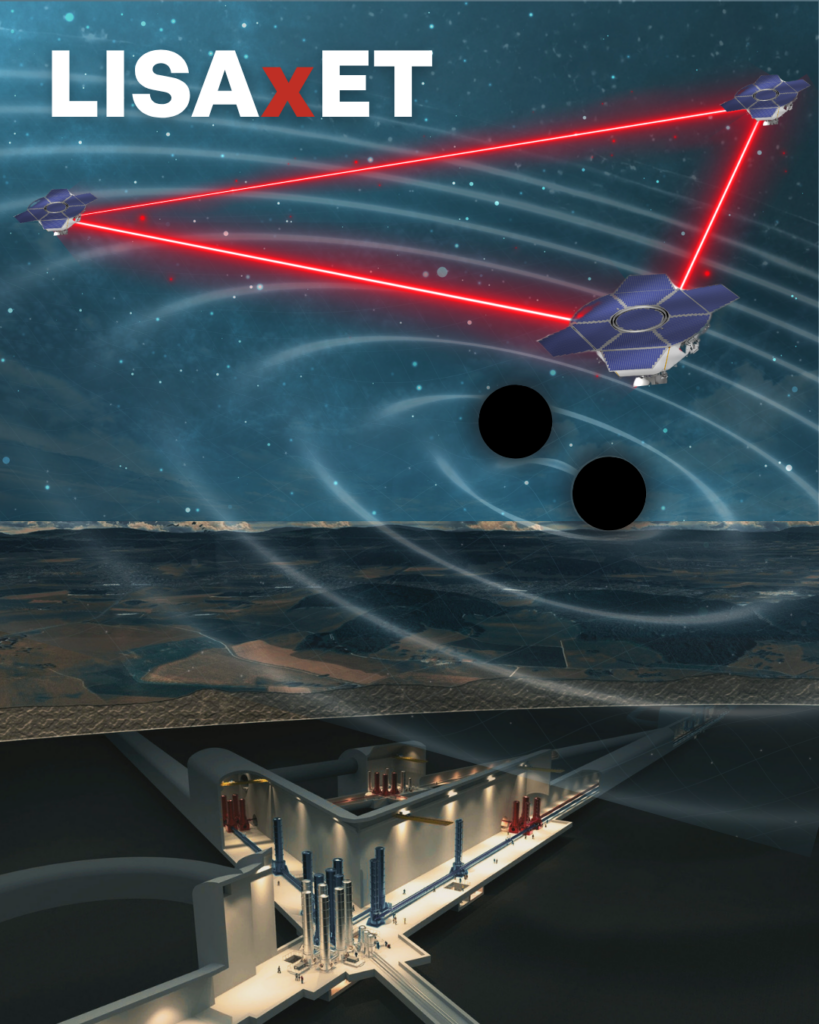
Since January 2026, more than forty members of the Einstein Telescope (ET) Collaboration and Laser Interferometer Space Antenna (LISA) Consortium have joined forces in a Synergy project. The aim of this first official shared project is to create a code that both collaborations can use for joint analyses. Because the LISA and the ET will detect different parts of the gravitational-wave spectrum, combining their analyses can give scientists a fuller picture of the signals and their origins, and better test theoretical models.
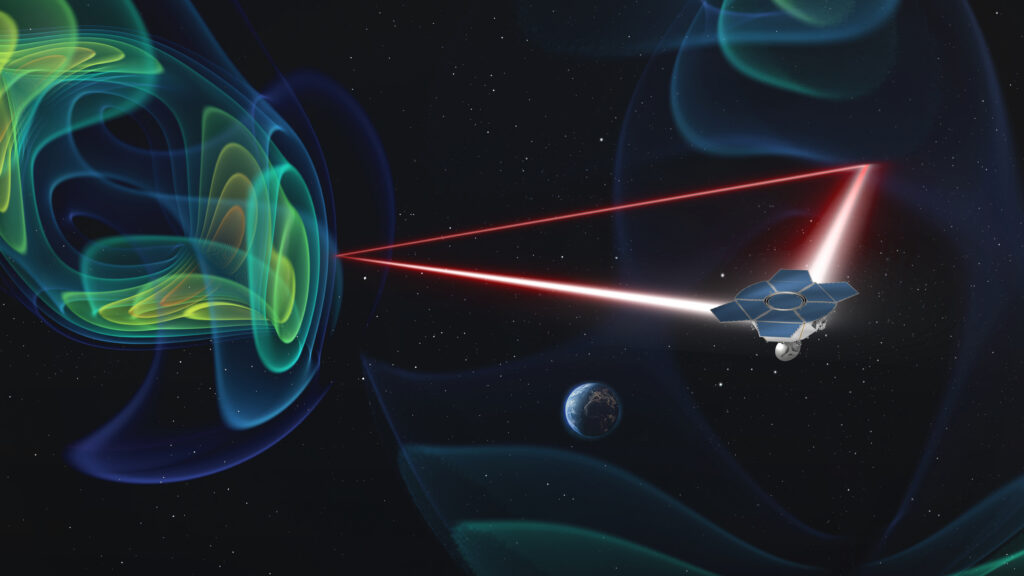
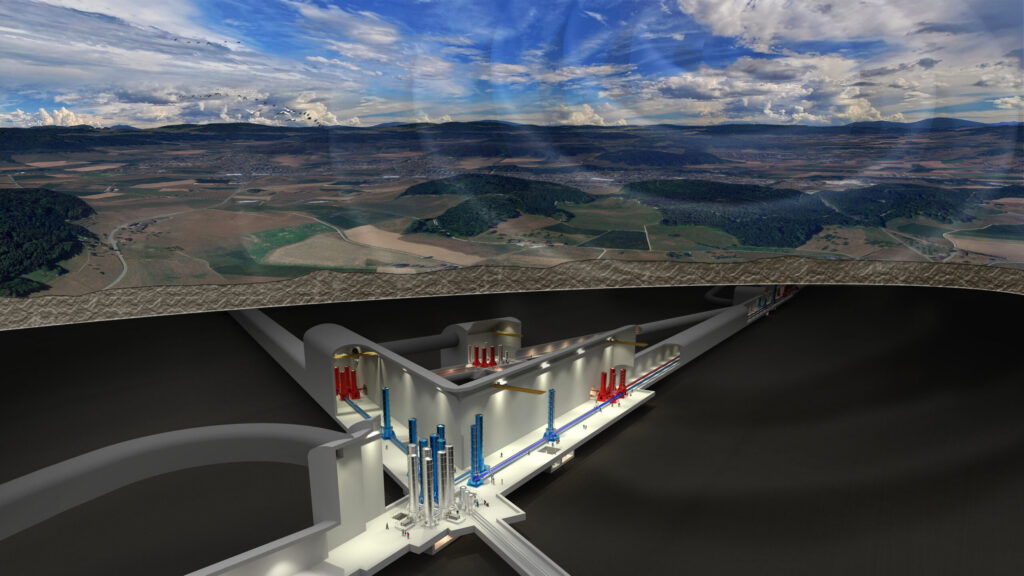
Illustration of LISA space mission with three spacecraft forming a triangle with red laser beams, two black circles representing black holes, and a cross-section of Earth showing underground Einstein Telescope facility.
Image: LISA Consortium/A. Paun; LISA Constellation by ESA, ET by Nikhef.

Searching for new classes of gravitational waves
Since the first detection of gravitational waves (GWs) a decade ago, gravitational-wave searches have become a valuable addition to the cosmological probes we use to study and unveil the mysteries of the universe. The LIGO/Virgo/KAGRA collaborations have already detected hundreds of GWs produced by mergers of compact objects, giving us a better understanding of the population properties of black holes or neutron stars. But a whole different class of signals is still out there, waiting to be detected. Those signals are produced by processes in the early Universe. Due to the weakness of gravitational interactions they travel freely through the cosmos, carrying information about physics that we cannot get in any other way.

These cosmological GW signals are among the main targets that future GW interferometers like the Laser Interferometer Space Antenna (LISA) and the Einstein Telescope (ET) will try to observe. These two detectors probe different frequency bands. LISA in space will cover the millihertz, while ET down here on Earth will cover the range from unity to thousands of hertz.

Different detectors, different frequency bands
Unfortunately, we do not know in advance at which frequency any specific signal will appear. This depends on the process that generated it which can span many orders of magnitude in energy. Roughly speaking, the frequency of a signal today is tied to the energy scale at which it was produced, which is unknown. This means that different frequency bands correspond to different epochs or periods of time. For example, GW associated with asteroid-mass primordial black holes would peak at LISA’s millihertz band, while the ones related to heavier black holes would produce a signal at smaller frequencies. A signal can appear strong in one band and only a bit in another, or be at its strongest somewhere in between where both experiments cannot detect it. In fact, the signals are not expected to completely appear in one detector’s band or in another. They could show up only partially, with the main contribution being outside of the detector range. So, if two (or more) GW detectors look at similar frequencies, their combined efforts could be crucial.

An artist’s impression of LISA. Image courtesy of ESA

This is the main reason for our Synergy project, the first official project between two GW communities (ET and LISA). Combining what different detectors see across the bands should make it easier to work out the shape of the background, separate the cosmological part (coming from the early-Universe) from the astrophysical one (produced more recently by astrophysical sources), and potentially tell apart models that would look basically the same through a single instrument.

An artist’s impression of ET. Image courtesy of Nikhef

A step towards shared code for gravitational wave detectors
There is also a practical side to this project. LISA and ET already work on overlapping questions, but the analysis codes and conventions have mostly grown up separately. This makes sharing work across the two communities harder than it should be. One of the goals of the project is to overcome this and build something that both sides can use.

The plan is to create a code that the collaborations can use together to perform a joint analysis between GW detectors, and developed to make it easy to add other detectors to the network, including future ones such as Cosmic Explorer in the US. 

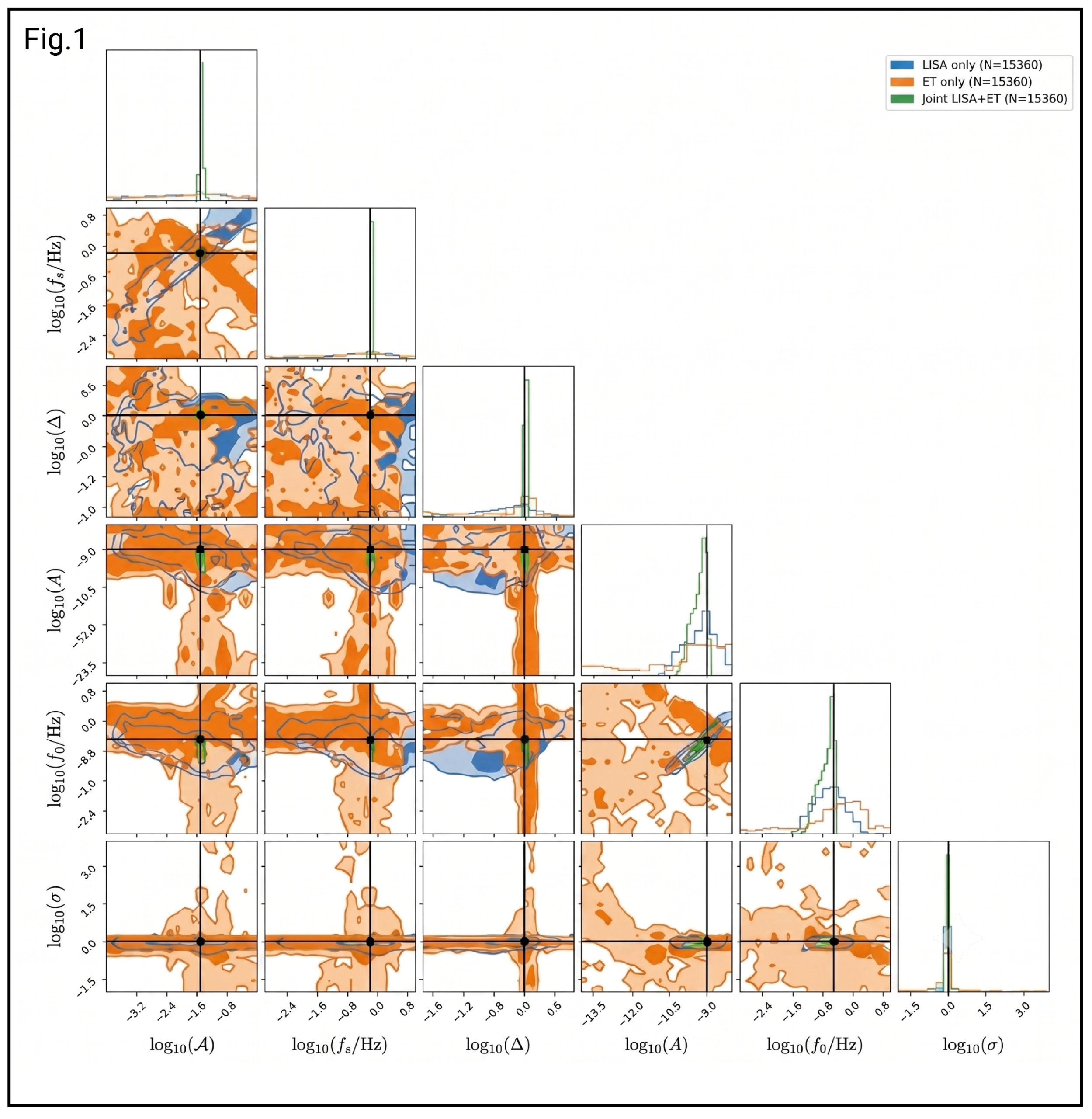
Preliminary tests (Fig.1) already showed the extreme gain in characterising GW signals when LISA and ET are considered together. Figure: LISA-ET Synergy Project
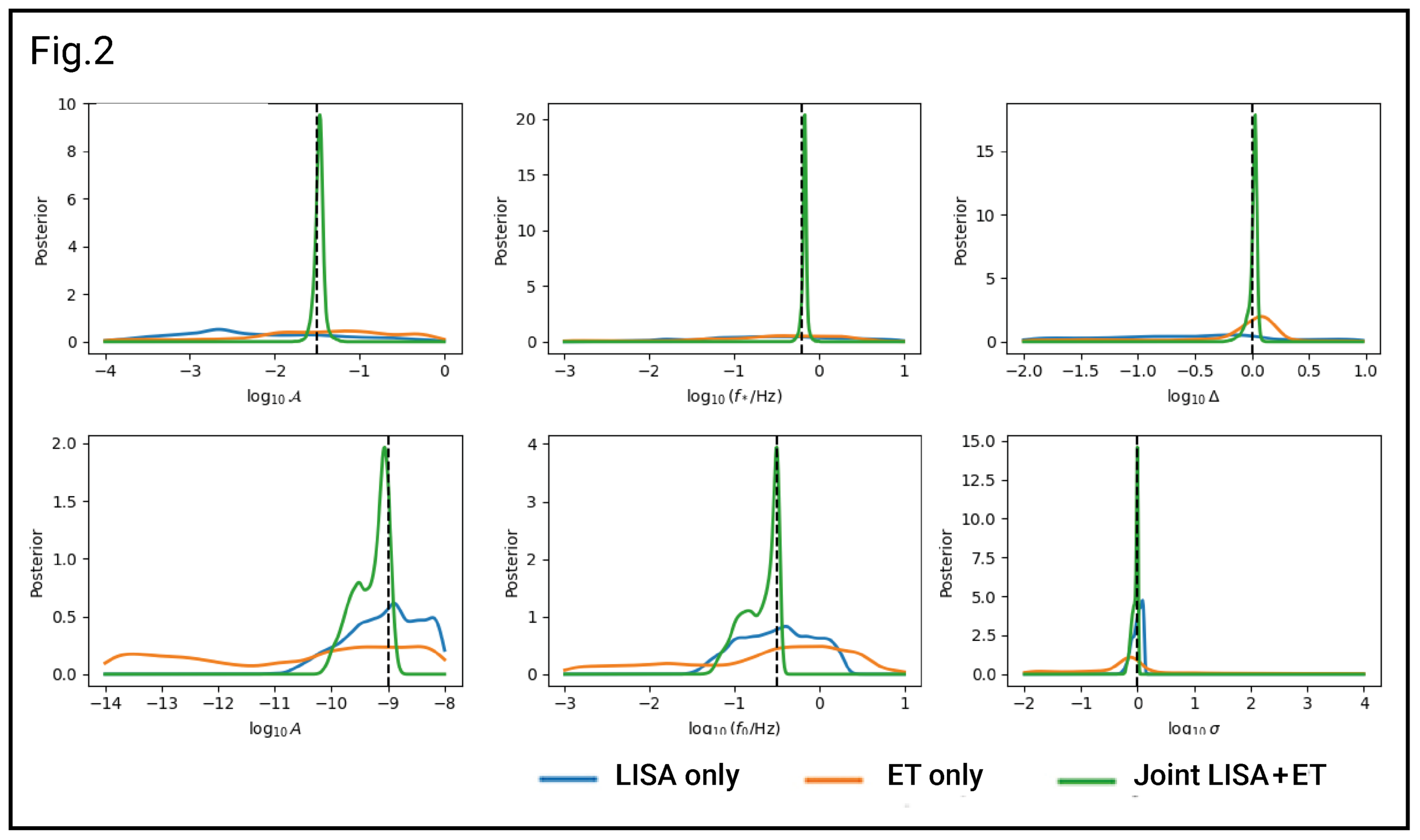
Fig.2 shows updated estimates about specific GW source parameters, obtained by combining prior knowledge with the data from both the detectors. These are so-called joint posteriors (green lines) and are compared here to posteriors from the single detectors (LISA only = blue lines, ET only = orange lines). LISA-ET Synergy Project

The ET-LISA Synergy Project started in January 2026, and has grown into an ambitious global undertaking. The project is coordinated by Antonio J. Iovino (NYU, Abu Dhabi) and Gabriele Perna (KBFI, Tallinn). More than forty people are involved so far from both the ET Collaboration and the LISA Consortium, spanning Europe, the United States, the United Kingdom and Asia and bringing  a mix of different expertise to both the theory and coding elements s of the project. Besides the actual coding work, the other main deliverables that will be produced are two scientific papers: one focuses on different cosmological GW signals and how they look across the bands, and the other introduces the code so the scientific community can easily use it.

Preliminary tests already showed the extreme gain in characterising GW signals when more detectors are considered together and we’re excited to explore the wider cosmological implications!
Antonio J. Iovino and Gabriele Perna, Project Coordinators

COSMO-26, August 24-28 2026 in Leiden

The 29th International Conference on Particle Physics and Cosmology (COSMO-26) will be hosted by Leiden University. This annual conference series, one of the largest venues for researchers at the intersection of particle physics and cosmology, brings together world experts to discuss the latest advancements in the field.

Topics

  • Gravitational Wave Cosmology
  • CMB
  • Neutrino cosmology
  • LSS and Weak gravitational lensing
  • Tensions/Status of LCDM
  • Primordial Black Holes
  • Cosmological magnetic fields
  • Inflation and primordial universe
  • Dark energy and modified gravity
  • Statistical inference in cosmology
  • Cosmological implications of Quantum Gravity
  • Dark matter

Invited Plenary Speakers

Kevork Abazajian
University of California Irvine

Alexandra Amon
Princeton University

Axel Brandenburg
NORDITA / Stockholm University /
Carnegie Mellon University

Chris van den Broeck
Utrecht University /
Nikhef

Erminia Calabrese
Cardiff University

Chiara Caprini
University of Geneva /
CERN

Jens Chluba
Joddrell Bank /
University of Manchester

Willem Elbers
Durham University

Simon Foreman
Arizona State University

Renata Kallosh
Stanford University

Eiichiro Komatsu
Max Planck Institute for Astrophysics /
Kavli IPMU

Andrii Neronov
Université Paris Cité /
EPFL

Alkistis Pourtsidou
Edinburgh University

Misao Sasaki
University of Tokyo / Kavli IPMU /
APCTP Pohang

Gary Shiu
University of Wisconsin Madison

Joop Schaye
Leiden University

Marko Simonovic
University of Florence

Filippo Vernizzi
IPhT-CEA Saclay

Session conveners

K. Bondarenko
S. Céspedes
P. Cole
W. Coulton
A. Duivenvoorden
C. Garcia Garcia
A. Garoffolo
M. Gervino
D. Glavan
H. Hildebrandt
O. Iarygina
B. Kavanagh
K. Kuijken
A. Malhotra
A. Nicola
M. Ovchynnikov
L. Roszkowski
E. Sellentin
B. Shakya
J. van de Vis
D.-G. Wang

Any inquiries can be sent to: cosmo-26(at)lorentz.leidenuniv.nl

Conference Website

QUEST 2026, September 23-25 in Pisa

This is the first edition of QUEST: Quantum Gravity, Early Universe, Space-Time and Theoretical Frontiers. This conference will be held in Pisa from 23rd to 25th September 2026 and is entirely organized by PhD students from the University of Pisa who are interested in Gravity, Quantum Field Theories and Cosmology.

With unprecedented precision tests of Einstein’s theory of gravitation and the ΛCDM model of the universe, a better theoretical understanding of fundamental theories is becoming increasingly important, in order to keep up with recent technological advancements. On the other hand, many questions remain open and lead us to look for extensions of these theories, such as the possibility of deviations from Einstein’s relativity and from the Standard Model of Particle Physics and Cosmology.

The aim of this conference is to bring together senior, junior and post-graduate researchers working at the interplay of Gravity and Cosmology, within the broader framework of Quantum Field Theory. Controversial and debated topics in modern theories of gravity, and new techniques in gauge and Generalized Symmetries theories, will be introduced with plenary talks from senior professors, followed by contributions from younger researchers. The final goal is to update participants on recent progress in modified gravity and cosmology, as well as their most recent Quantum Field Theory approaches, and potentially foster new collaborations within the community.

Contributions from participants will be in the form of invited seminars, submitted talks and posters. The deadline for submission of an abstract for a contributed talk or a poster is September 1st, 2026.

No registration fee is required.
Coffee breaks are offered by the organization.

This conference has received financial support from the University of Pisa and INFN, Sezione di Pisa.

Local and Scientific Organizers

Pierre Béchaz, Lorenzo Benfatto, Fabrizio Chicconi, Matteo Orso, Luca Parente, Dario Rossi

Conference Website

New Horizons in Quantum Gravity, April 11-16 2027 at Ecole de Physique des Houches

Taking place at the prestigious Ecole de Physique des Houches near Mont Blanc, on April 11-16, 2027, this doctoral school is dedicated to young researchers in classical and quantum gravity. It covers advanced topics in general relativity -covariant phase space, boundary symmetries, edge modes- and the recent developments they led to in quantum gravity, including algebra of observables, celestial holography and the blooming interface with quantum reference frames. Leading researchers at the forefront of quantum gravity and quantum information, will teach the fundamentals and discuss the current exciting lines of research.

The school is organized by:

Luca Ciambelli – Perimeter Institute, Canada Flaminia Giacomini – University of Rome Tor Vergata, Italy Etera Livine – ENS Lyon, CNRS, France Natalie Paquette – University of Washington, USA

Confirmed lecturers are Glenn BARNICH, Luca CIAMBELLI, Roberto EMPARAN, Flaminia GIACOMINI, Steve GIDDINGS, Etera LIVINE, Monica PATE, Ana-Maria RACLARIU, Jonathan SORCE.

Registration is now open !

School Website

Cosmology from Home 2026, September 21st – October 2nd

Cosmology from Home is an annual online cosmology conference with an innovative format, which produces a dynamic and collaborative workshop experience within the online domain. The format includes the use of pre-recorded talks, and a combination of asynchronous and scheduled live discussions. A permanently available and freely-navigated discussion space also facilitates ongoing, organic discussions. The conference will bring together cosmologists from around the world to discuss the current state of cosmology at the interface of theory and observations.

This year, the over-arching conference theme will be “interdisciplinary within cosmology”. Not all talks need to be interdisciplinary, but all talks will be heavily encouraged to be aimed at general cosmology researchers, not subject-level experts.

Conference Website

LIGO-Virgo-KAGRA Collaboration Meeting September 21 – 25, 2026 at IUCAA, Pune

The September 2026 LIGO–Virgo–KAGRA (LVK) Collaboration Meeting will be held in Pune, India. 

Venue: IUCAA, Pune

Date: September 21 – 25, 2026

Registration Fees: There will be a registration fee for this conference. The details of registration fee payment will be updated in due course in the Registration page.

Coordinator:

  • Sanjit Mitra(IUCAA)

Code of conduct:

Meeting participants are expected to follow the LVK Code of Conduct:
https://dcc.ligo.org/LIGO-M1900037

Participants will avoid any inappropriate actions or statements based on individual characteristics such as age, race, ethnicity, sexual orientation, gender identity, gender expression, marital status, nationality, political affiliation, ability status, or educational background. Disruptive or harassing behaviour of any kind will not be tolerated. Harassment includes but is not limited to inappropriate or intimidating behaviour and language, unwelcome jokes or comments, unwanted touching or attention, offensive images, unwelcome photography, and stalking. Disruptive behaviour includes instances of disrespect and lack of civility in interactions with colleagues. All participants are expected at all times to deal with and address their fellow colleagues with respect and courtesy. This includes, but is not limited to, behaviour in in-person meetings, virtual (remote) meetings and email communications.

For any queries: Please write email to – lvk.pune(at)iucaa.in

Meeting Website