How is laser interferometry performed in space?
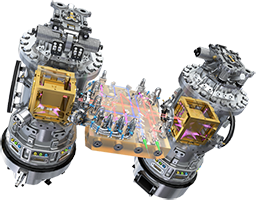
LISA´s payload consists of two identical units on each spacecraft. Each unit contains a Gravitational Reference Sensor (GRS) with an embedded free-falling test mass that acts both as end point of the optical length measurement and as geodesic reference test particle. A telescope transmits the laser light along the arm and also receives the weak light (few hundred pico-Watts!) from the other end. Laser interferometry is performed on an optical bench in between the telescope and the GRS.
What are the test masses made of?
The test masses are 46 mm cubes, made from a dense non-magnetic Au-Pt alloy and shielded by the Gravitational Reference Sensor (GRS). The GRS core is a housing of electrodes, at several mm separation from the test mass, used for precision capacitive sensing and electrostatic force actuation in all non-interferometric degrees of freedom. The GRS also includes fibers for UV light injection for photoeletric discharge of the test mass and a caging mechanism for protecting the test mass during launch and then releasing it in orbit. The GRS technology is a direct heritage from LISA Pathfinder.
How does the spacecraft remain centred on the test masses?
The spacecraft are actively controlled to remain centred on the test masses along the interferometric axes, without applying forces on the test masses on these axes. To establish this “drag-free operation”, a housing around the test mass senses the relative position of test mass and spacecraft, and a control system commands the spacecraft’s thrusters to follow the free-falling mass.